Seminar ASAI, Teologi Kesehatan Pesantren; Rasionalitas Respon Pesantren terhadap Pandemi Covid-19

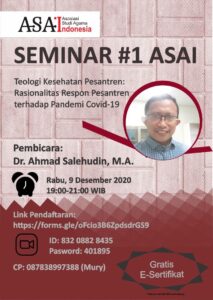
Asosisasi Studi Agama Indonesia pada tanggal 09 Desember 2020 telah mengadakan Seminar seri 1, dengan mengusung tema Teologi Kesehatan Pesantren; Rasionalitas Respon Pesantren terhadap Pandemi Covid-19. Berbagai pandangan mengenai covid-19, seperti mengatakan bahwa covid ini adalah sebuah musibah yang bisa menimpa siapa saja. Sehingga siapa pun yang mendapatkan musibah berarti harus sabar dalam menghadapi ujian tersebut dan Bersama-sama mencari sebuah solusi dalam menghadapi musibah tersebut. Adapun hal lainnya masih menganggap bahwa covid-19 ini sebuah konspirasi dari para golongan elit sana.

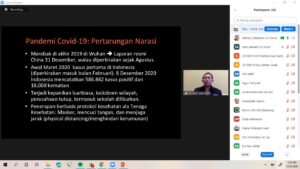
Lalu bagaimana mengenai rasionalitas respon pesantren terhadap pandemi covid-19, Dr. Ahmad Salehuddin sebagai narasumber memaparkan, bermula dari pesantren memiliki cara tersendiri yakni dengan perlindungan spiritual. Hal yang dimaksudkan dengan perlindungan spiritual yakni amalan-amalan yang dimiliki, seperti memperbanyak shalawat, bacaan alfatihah, memperbanyak istigfar dan lain sebagainya.

Para peserta dalam acara ini sangatlah mengapresiasi acara ini, diharapkan adanya keberlanjutan menganai kajian studi agama dalam hal lainnya. Sehingga harapan besarnya bahwa kajian studi agama dalam menjadi sebuah kajian lebih menarik dan banyak dipelajari khalayak umum. Pada akhir acara ditutup dengan pemaparan bahwa kebijakan apapun pemerintah harus mempertimbangkan rasionalitas komunitas tersebut.

Teologi Kesehatan Pesantren: Rasionalitas Respon Pesantren terhadap Pandemi COVID-19

Seminar seri 1

Pesantren memiliki cara-cara otentik untuk menghadapi pandemi Covid-19 yang berbeda dengan cara-cara yang diambil oleh komunitas kesehatan. Covid-19 merupakan makhluk Tuhan yang bekerja hanya atas perintah Tuhan. Oleh Karena itu, pesantren menerapkan cara-cara lahiriah dan batiniah sekaligus dalam menghadapi Covid-19. Cara-cara lahiriah dilakukan dengan menjalankan protokol kesehatan secara adaptif dan kontekstual, sementara cara batiniah dilakukan dengan praktik-praktik ritual melalui doa, sholat, dzikir dan membaca sholawat. Pandangan teologis yang berorientasi teosentris dan antroposentris ini memperlihatkan salah satu sisi moderasi pesantren.
Bagaimana selanjutnya? Dr. Ahmad Salehudin akan berbagi Hasil Penelitian “Teologi Kesehatan Pesantren: Rasionalitas Respon Pesantren terhadap Pandemi COVID-19” dalam Seminar#1 ASAI,
Hari: Rabu, 9 Desember 2020
Pukul: 19:00-21:00 WIB
ID: 832 0882 8435
Pasword: 401895
Ikutan yuk!

Isi Link Formulir Pendaftarannya ya:
https://forms.gle/oFcio3B6ZpdsdrGS9

The 8th National Symposium on Religious Studies: Existing in Studies Amidst the Pandemic

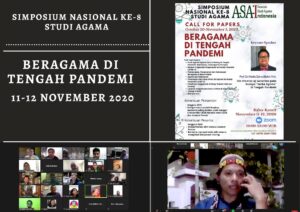
Yogyakarta, Asosiasi Studi Agama Indonesia (ASAI) menggelar Simposium Nasional ke-8 Studi Agama dengan “Beragama di Tengah Pandemi”. Acara diselenggarakan secara virtual/online selama dua hari yakni pada tanggal 11-12 November 2020 setiap pukul 19:00-21:00 WIB. Selain menjadi agenda rutin tahunan, Simposium Asosisasi Studi Agama Indonesia juga mengikat kembali akademisi, peneliti dan pekerja sosial yang mempunyai fokus terhadap studi agama. Dalam sambutannya ketua ASAI Ahmad Muttaqin, M.Ag., M.A., Ph. D. menyampaikan “Walaupun di tengah pandemi, semoga kita masih bisa tetap eksis dalam kajian studi agama.” ASAI pun diharapkan menjadi wadah akademik di wilayah studi agama. Continue reading “Simposium Nasional ke-8 Studi Agama: Eksis dalam Kajian di Tengah Pandemi” →

Rearticulating Religious Studies Research: Insights from the 2019-2024 ASAI Board Work Meeting

Oleh: Muryana

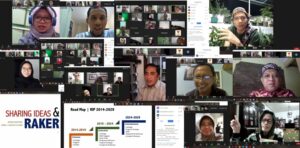
The ASAI Board Work Meeting took place during the ongoing Covid-19 pandemic. The meeting was held online and comprised several plenary sessions, divisions, and additional plenary discussions from August 5 to August 25, 2020. This event resulted in various formulations related to the Religious Studies. Research emerged as a key topic discussed in every session.

The ongoing COVID-19 pandemic presents a significant challenge for the global community. One notable impact has been the postponement of the 2019-2024 ASAI Board Work Meeting, which was originally scheduled for March 23-24, 2020. Due to the circumstances, the daily officer team proposed that the meeting be held online using a platform commonly utilized for virtual meetings. This proposal received approval from all management members for the 2019-2024 term.

Continue reading “Mengartikulasikan Kembali Riset SAA: Catatan Raker ASAI 2019-2024” →

Online Workshop On Judaism: Penguatan Studi Agama-Agama Saat Pandemi

pelatihan

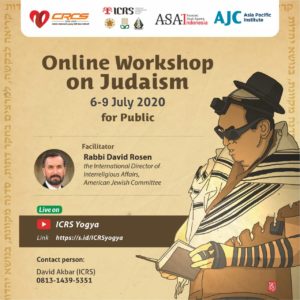
“Online Workshop on Judaism”, judul kegiatan bersama yang diselenggarakan oleh empat lembaga pada tanggal 6-9 Juli 2020. Workshop ini membincangkan Agama Yahudi dengan pembicara dari insider, Ulama Yahudi di Jerusalem dan peneliti, outsider Agama Yahudi di Indonesia. Sebuah workshop yang membangun harapan besar, bahwa setiap peserta yang terlibat berpartisipasi aktif dan mengembangkannya dalam kegiatan akademik.

Kerjasama berhasil dilakukan dengan komitmen bersama dan peran masing-masing lembaga. CRCS menginisiasi kegiatan workshop bersama ini dengan mengundang Rabbi David Rosen, the International Director of Interreligious Affairs, American Jewish Committee. ICRS sebagai panitia penyelenggara dalam kegiatan ini, mulai dari publikasi poster, menghubungi peserta, melakukan survei sebelum dan sesudah acara, menjadi tuan rumah (meeting host) hingga memberikan hak yang dijanjikan kepada peserta, yaitu sertifikat. Sementara itu, ASAI sebagai asosiasi studi agama mendorong para anggotanya di seluruh Indonesia untuk berpartisipasi aktif dalam acara dan mengembangkannya dalam studi agama selanjutnya. Dari ketiga lembaga ini pula, secara bergantian moderator berasal. Ada Dr. Zainal Abidin Bagir pada hari pertama, Dr. Mohammad Iqbal Ahnaf pada hari kedua, dan Dr. Leonard Chrysostomos E. pada hari ketiga serta Dr. Ahmad Salehudin pada hari terakhir. Acara ini juga didukung oleh Asia Pasific Institute.

Continue reading “Online Workshop On Judaism: Penguatan Studi Agama-Agama Saat Pandemi” →

National Webinar: The Role of Religion in Enhancing Community Spirituality During the Covid-19 Pandemic Towards the New Normal

webinar

In recent months, the world has been shaken by the Covid-19 outbreak, caused by a virus for which, as of now, there is no cure or vaccine. In response to the ongoing search for a vaccine to combat this outbreak, the government has implemented new measures for a "new normal."

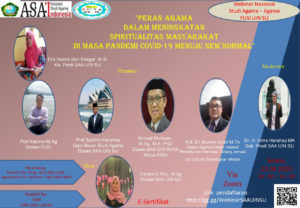
The concept of the "New Normal" refers to the continuation of daily life while incorporating essential considerations, such as maintaining cleanliness and adhering to health protocols recommended by the government. Beyond health measures, it is also important to foster community spirituality. How do spirituality and religion contribute to this effort? To address this, the Religious Studies Program at UIN North Sumatra organized a national webinar in collaboration with the Indonesian Religious Studies Association (ASAI) and the Student Association of the Department of Religious Studies at UIN North Sumatra. The webinar is titled "The Role of Religion in Enhancing Community Spirituality During the Covid-19 Pandemic Towards the New Normal."

The event took place on Tuesday, June 23, 2020, from 2:00 PM to 4:00 PM. Several speakers participated, including: Dra. Husna Sari Siregar (Head of the Religious Studies Program at UIN North Sumatra), Prof. Katimin (Dean of the Faculty of Ushuluddin and Islamic Studies at UIN North Sumatra), Prof. Syahrin Harapa (Professor of Religious Studies at UIN North Sumatra), Ahmad Muttaqin, M.Ag., M.A., Ph.D (Head of ASAI and Head of the Master of Religious Studies Program at UIN Sunan Kalijaga Yogyakarta), Rev. Dr. Boimin Sirait (Lecturer of Christian Religion at the State University of Medan). The session was moderated by Dr. H. Indra Harapa (Secretary of the Religious Studies Program at UIN North Sumatra).

For those interested in attending the event, please register at and contact 081268314152/081260164428.

The New Mosque after the Covid-19 Pandemic

Alma’a Cinthya Hadi

alma

The government has implemented various measures and policies in response to the COVID-19 pandemic. These measures include recommendations for social distancing (which later evolved into physical distancing), working from home, and enforcing Large-Scale Social Restrictions (PSBB). Individuals who need to go outside are required to wear masks, wash their hands with soap, and thoroughly clean themselves upon returning home. The COVID-19 pandemic has compelled people to adapt to a new way of life that differs significantly from their usual routines.

The mosque is one of the places directly affected by the PSBB policy. Mosques, which are typically used as gathering spots for worship, are particularly vulnerable to becoming sites for the transmission of Covid-19. This vulnerability led to appeals and prohibitions advising people to temporarily suspend Friday prayers and instead perform Dhuhur prayers. Additionally, individuals were encouraged to conduct tarawih prayers and Eid prayers at home, as recommended by the Ministry of Religion, Muhammadiyah, and Nahdlatul Ulama (NU). However, not all Indonesian Muslims, especially regarding Friday prayers, immediately complied with the directives issued by the Ministry of Religion and the two largest Islamic organizations in Indonesia.

Mosques During the Pandemic

Mungkin sebagian besar umat Islam tidak pernah membayangkan jika pada satu waktu mereka tidak boleh berkumpul (beribadah) di masjid. Namun kenyataan itu harus dihadapi saat ini. Musababnya adalah  virus kecil bermahkota yang popular dengan sebutan Corona. Continue reading “New Masjid Pasca Pandemik Covid-19” →

Reviving the Spirit of Memayu Hayuning Bawono Amid the Pandemic

Muhamad Fauzi Zakaria

fauzi

Memayu Hayuning Bawono is a noble philosophy of the Javanese people that translates to "Beautifying a beautiful world." This concept is deeply rooted in Javanese culture and serves as a spiritual guide for maintaining harmony among people and between humanity and the universe.

Memayu Hayuning Bawono, in a broader sense, refers to a way of life that individuals should follow to enhance personal piety, foster social relationships, and express gratitude for the blessings received from God through the creation of the universe and its resources. The three dimensions, individuals, society, and nature interact and influence one another.

Humans do not exist in isolation; they share the world with others who have equal rights to live and pursue their livelihoods. Efforts to meet life’s needs require social interaction among people, but they also depend on the universe as a source of resources. Often, attempts to sustain human life face various challenges, including conflicts between individuals and natural disasters, which can hinder people from fully meeting their needs.

Continue reading “Menyerukan Kembali Semangat Memayu Hayuning Bawono di Tengah Pandemi” →

Islam dalam Keadilan Aristoteles

M. Khusnun Niam

M. Khusnun Niam

Aristotle was a philosopher born in 384 BC in the region of Macedonia, specifically in Stagira. At the age of 15, he was abandoned by his father and subsequently raised by his father's younger brother, Proxenus. When he was over 17 years old, Aristotle moved to Athens to attend Plato's Academy. There, he studied under Plato for 20 years and was appointed as a teacher at the Academy after Plato's death. Following this, Aristotle left the Academy and spent 12 years wandering, during which time he established several other Academies. He produced many works throughout his life and passed away in 322 BC in Chalcis, Greece.

Aristotle's monumental works focus on two main topics: politics and ethics. This article will briefly explore Aristotle's ethical thoughts, particularly his views on justice and the concept of justice he presents. Additionally, Aristotle's understanding of justice has parallels in Islamic teachings, which also emphasize justice. Therefore, it is important to examine the relationship between Aristotle's concept of justice and Islamic principles.

Islam is a religion that encompasses both normativity and historicity. As a belief system, it involves the faith of individuals, particularly in relation to their worship of the Creator. On the other hand, Islam as a field of study highlights aspects that can be examined for various purposes. Continue reading “Islam dalam Keadilan Aristoteles” →

The COVID-19 Pandemic and the Future of Religions

Ahmad Salehudin

ahmad salehudin

The COVID-19 pandemic has dramatically compelled all religions to adapt and transform their traditional practices. In the Muslim world, both the Grand Mosque in Mecca and the Prophet’s Mosque in Medina, Islam’s two holiest sites, were temporarily closed. In Bali, Indonesia, the annual Ogoh-ogoh parade, held on the eve of Nyepi Day, and the Omed-Omedan Festival, a mass kissing ritual between teenagers traditionally held the day after, were both canceled (www.liputan6.com/regional/read/4210627). However, the Melasti ceremony, a ritual of self-purification, continued with strict adherence to COVID-19 health protocols (www.bbc.com/indonesia/indonesia-52001349). Similarly, Christian observances were profoundly affected. The Easter Mass, normally attended by thousands at St. Peter’s Basilica, was conducted without a physical congregation for the first time in history. Pope Francis led the service virtually (https://www.kompas.com/global/read/2020/04/12). A comparable shift occurred in the Buddhist community, where the 2020 Vesak Day celebration on Thursday, May 7, was held online. The Vesak Puja Bakti service was live-streamed, allowing Buddhists to participate from their homes (https://tirto.id/merayakan-waisak-di-tengah-pandemi-covid-19-fni3).

At the beginning of the COVID-19 outbreak, several religious groups, guided by their beliefs, chose to challenge the pandemic. There were at least two factors that contributed to this stance. First, many members believed that God's power would prevail over the challenges posed by COVID-19. This belief was evident in numerous messages circulating in WhatsApp groups, encouraging followers to continue attending places of worship. Second, there was a conviction among these groups that individuals should fear no one but God, as life and death are determined by Him. This belief often led them to disregard preventive measures aimed at avoiding the virus. Additionally, many religious groups hold the worldview that life on Earth is temporary, while the afterlife is eternal. This perspective caused them to view COVID-19 not as a serious threat but merely as a potential means of ending life in this fleeting existence.

A religious attitude can pose dangers not only to oneself and one's community but also to others. Religious gatherings have become significant hotspots for the spread of COVID-19. In South Korea, more than half of the reported COVID-19 cases are linked to the Shincheonji Church of Jesus. Similarly, the Tabligh Congregation has been identified as a major source of COVID-19 outbreaks in India, Malaysia, and Gowa, Indonesia. In Indonesia, the Annual Synod Meeting of the Protestant Church in Western Indonesia (GPIB), held from February 26 to 29 in Bogor City, along with a religious seminar of the Indonesian Bethel Church (GBI) from March 3 to 5 in West Bandung Regency, served as starting points for the spread of the virus. It is important to recognize, however, that religious activities are not the sole contributors to the spread of COVID-19; many other activities that involve physical contact can also facilitate transmission. Continue reading “Wabah COVID-19 dan Masa Depan Agama-Agama” →