
Oleh: Muryana
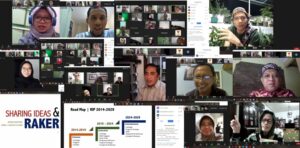
The ASAI Board Work Meeting took place during the ongoing Covid-19 pandemic. The meeting was held online and comprised several plenary sessions, divisions, and additional plenary discussions from August 5 to August 25, 2020. This event resulted in various formulations related to the Religious Studies. Research emerged as a key topic discussed in every session.
The ongoing COVID-19 pandemic presents a significant challenge for the global community. One notable impact has been the postponement of the 2019-2024 ASAI Board Work Meeting, which was originally scheduled for March 23-24, 2020. Due to the circumstances, the daily officer team proposed that the meeting be held online using a platform commonly utilized for virtual meetings. This proposal received approval from all management members for the 2019-2024 term.
The Board Work Meeting was conducted via Zoom. It was originally scheduled for August 5, 2020, from 19:00 to 22:00 WIB. However, due to time differences across East, Central, and West Indonesia, it was decided that the Board Work Meeting would only be two hours long, starting at 19:00 WIB. In practice, the meeting extended to 22:00 WIB. During this Board Work Meeting, it was agreed to hold a Plenary Meeting on August 19, 2020, based on the outcomes of the meetings held within each division. Subsequent meetings took place between the divisions. However, the Plenary Meeting was later postponed to August 25, 2020, to finalize the work program results from each division before the plenary session.
Ismatu Ropi, Ph.D., from the Department of Religious Studies at UIN Syarif Hidayatullah Jakarta, was a speaker at the Board Work Meeting held on August 5, 2020. He stated, "Taking care of Religious Studies is the same as taking care of common sense." This statement reflects ASAI's role as a professional institution and intermediary organization aiming to develop the curriculum for Religious Studies in Indonesia. This perspective raises several questions about how Religious Studies has articulated its research findings to date. Subsequent inquiries include: What is the model of Religious Studies in Indonesia? How can each Religious Studies program in Indonesia cultivate its unique characteristics? How can Religious Studies move beyond a predominantly historical approach in its analyses? Additionally, Dr. Roro Sri Rejeki Waluyojati, from the Department of Religious Studies at UIN Sunan Gunung Djati Bandung, posed the question, "What is the ideal prototype of Religious Studies students?" In response, Dr. Ustadi Hamzah from the Religious Studies at UIN Sunan Kalijaga Yogyakarta explained that there are distinct levels of study between bachelor's and master's programs. Furthermore, Samsul Maarif, Ph.D., from the Center for Religious and Cross-Cultural Studies (CRCS) at Gadjah Mada University in Yogyakarta, suggested that academic journals could serve as a platform for advancing knowledge in teaching and discussions. Thematic conferences and studies in the field of Religious Studies are expected to be conducted more frequently in the future.
The questions raised in the Board Work Meeting were addressed in meetings held by each ASAI Department from August 5 to August 25, 2020. Based on the work programs developed and submitted by each department, it became clear that there were several overlaps. On August 25, 2020, the ASAI Plenary Meeting agreed to reformulate these programs into a unified work program for ASAI officer for the 2019-2020 period. This work program will be structured around various proposals related to: Branding of Religious Studies, Member Development, Overseas Cooperation, A Digital Library for ASAI Members, Implementation of Independent Campus and Independent Learning in Religious Studies, Financing of ASAI Activities, Collaborative Research, and Values of Religious Studies. These proposals were submitted by Ahmad Muttaqin, Ph.D. (General Chairperson of ASAI), Dr. Sekar Ayu Aryani (Expert Council of ASAI), and Samsul Maarif, Ph.D. (Coordinator of the ASAI Advocacy and Law Department). Additionally, Prof. Alef Theria Wasyim raised a question regarding the values of religious studies that have yet to be realized: Should we focus on studying religions, studying into religions, studying of religions, studying from religions, or studying about religions? Research has also become a significant agenda item and serves as the foundation for this period's work program. However, questions remain about whether research should be treated as a separate function, implying that only the research and development department can handle it or whether research should be integrative, functioning as a foundational aspect for every program that is implemented.
The ASAI 2019-2024 Board Work Meeting and Plenary Meeting have concluded successfully, with 50 percent of the officer in attendance. On August 5, 2020, 32 officer members participated in the Board Working Meeting. Additionally, on August 25, 2020, 27 officer members formally conveyed their agreement to the work program for each departement presented during the Plenary Meeting.

 English (UK)
  Bahasa Indonesia
Bravo ASAI…