Online Workshop On Judaism: Penguatan Studi Agama-Agama Saat Pandemi

pelatihan

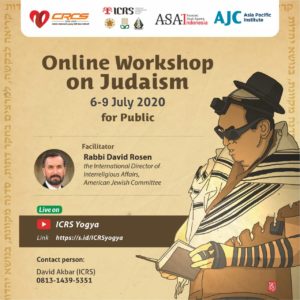
“Online Workshop on Judaism”, judul kegiatan bersama yang diselenggarakan oleh empat lembaga pada tanggal 6-9 Juli 2020. Workshop ini membincangkan Agama Yahudi dengan pembicara dari insider, Ulama Yahudi di Jerusalem dan peneliti, outsider Agama Yahudi di Indonesia. Sebuah workshop yang membangun harapan besar, bahwa setiap peserta yang terlibat berpartisipasi aktif dan mengembangkannya dalam kegiatan akademik.

Kerjasama berhasil dilakukan dengan komitmen bersama dan peran masing-masing lembaga. CRCS menginisiasi kegiatan workshop bersama ini dengan mengundang Rabbi David Rosen, the International Director of Interreligious Affairs, American Jewish Committee. ICRS sebagai panitia penyelenggara dalam kegiatan ini, mulai dari publikasi poster, menghubungi peserta, melakukan survei sebelum dan sesudah acara, menjadi tuan rumah (meeting host) hingga memberikan hak yang dijanjikan kepada peserta, yaitu sertifikat. Sementara itu, ASAI sebagai asosiasi studi agama mendorong para anggotanya di seluruh Indonesia untuk berpartisipasi aktif dalam acara dan mengembangkannya dalam studi agama selanjutnya. Dari ketiga lembaga ini pula, secara bergantian moderator berasal. Ada Dr. Zainal Abidin Bagir pada hari pertama, Dr. Mohammad Iqbal Ahnaf pada hari kedua, dan Dr. Leonard Chrysostomos E. pada hari ketiga serta Dr. Ahmad Salehudin pada hari terakhir. Acara ini juga didukung oleh Asia Pasific Institute.

Continue reading “Online Workshop On Judaism: Penguatan Studi Agama-Agama Saat Pandemi” →

National Webinar: The Role of Religion in Enhancing Community Spirituality During the Covid-19 Pandemic Towards the New Normal

webinar

In recent months, the world has been shaken by the Covid-19 outbreak, caused by a virus for which, as of now, there is no cure or vaccine. In response to the ongoing search for a vaccine to combat this outbreak, the government has implemented new measures for a "new normal."

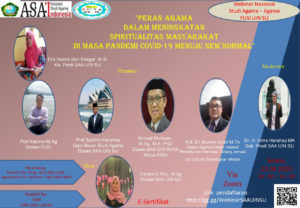
The concept of the "New Normal" refers to the continuation of daily life while incorporating essential considerations, such as maintaining cleanliness and adhering to health protocols recommended by the government. Beyond health measures, it is also important to foster community spirituality. How do spirituality and religion contribute to this effort? To address this, the Religious Studies Program at UIN North Sumatra organized a national webinar in collaboration with the Indonesian Religious Studies Association (ASAI) and the Student Association of the Department of Religious Studies at UIN North Sumatra. The webinar is titled "The Role of Religion in Enhancing Community Spirituality During the Covid-19 Pandemic Towards the New Normal."

The event took place on Tuesday, June 23, 2020, from 2:00 PM to 4:00 PM. Several speakers participated, including: Dra. Husna Sari Siregar (Head of the Religious Studies Program at UIN North Sumatra), Prof. Katimin (Dean of the Faculty of Ushuluddin and Islamic Studies at UIN North Sumatra), Prof. Syahrin Harapa (Professor of Religious Studies at UIN North Sumatra), Ahmad Muttaqin, M.Ag., M.A., Ph.D (Head of ASAI and Head of the Master of Religious Studies Program at UIN Sunan Kalijaga Yogyakarta), Rev. Dr. Boimin Sirait (Lecturer of Christian Religion at the State University of Medan). The session was moderated by Dr. H. Indra Harapa (Secretary of the Religious Studies Program at UIN North Sumatra).

For those interested in attending the event, please register at and contact 081268314152/081260164428.

The New Mosque after the Covid-19 Pandemic

Alma’a Cinthya Hadi

alma

The government has implemented various measures and policies in response to the COVID-19 pandemic. These measures include recommendations for social distancing (which later evolved into physical distancing), working from home, and enforcing Large-Scale Social Restrictions (PSBB). Individuals who need to go outside are required to wear masks, wash their hands with soap, and thoroughly clean themselves upon returning home. The COVID-19 pandemic has compelled people to adapt to a new way of life that differs significantly from their usual routines.

The mosque is one of the places directly affected by the PSBB policy. Mosques, which are typically used as gathering spots for worship, are particularly vulnerable to becoming sites for the transmission of Covid-19. This vulnerability led to appeals and prohibitions advising people to temporarily suspend Friday prayers and instead perform Dhuhur prayers. Additionally, individuals were encouraged to conduct tarawih prayers and Eid prayers at home, as recommended by the Ministry of Religion, Muhammadiyah, and Nahdlatul Ulama (NU). However, not all Indonesian Muslims, especially regarding Friday prayers, immediately complied with the directives issued by the Ministry of Religion and the two largest Islamic organizations in Indonesia.

Mosques During the Pandemic

Mungkin sebagian besar umat Islam tidak pernah membayangkan jika pada satu waktu mereka tidak boleh berkumpul (beribadah) di masjid. Namun kenyataan itu harus dihadapi saat ini. Musababnya adalah  virus kecil bermahkota yang popular dengan sebutan Corona. Continue reading “New Masjid Pasca Pandemik Covid-19” →

The COVID-19 Pandemic and the Future of Religions

Ahmad Salehudin

ahmad salehudin

The COVID-19 pandemic has dramatically compelled all religions to adapt and transform their traditional practices. In the Muslim world, both the Grand Mosque in Mecca and the Prophet’s Mosque in Medina, Islam’s two holiest sites, were temporarily closed. In Bali, Indonesia, the annual Ogoh-ogoh parade, held on the eve of Nyepi Day, and the Omed-Omedan Festival, a mass kissing ritual between teenagers traditionally held the day after, were both canceled (www.liputan6.com/regional/read/4210627). However, the Melasti ceremony, a ritual of self-purification, continued with strict adherence to COVID-19 health protocols (www.bbc.com/indonesia/indonesia-52001349). Similarly, Christian observances were profoundly affected. The Easter Mass, normally attended by thousands at St. Peter’s Basilica, was conducted without a physical congregation for the first time in history. Pope Francis led the service virtually (https://www.kompas.com/global/read/2020/04/12). A comparable shift occurred in the Buddhist community, where the 2020 Vesak Day celebration on Thursday, May 7, was held online. The Vesak Puja Bakti service was live-streamed, allowing Buddhists to participate from their homes (https://tirto.id/merayakan-waisak-di-tengah-pandemi-covid-19-fni3).

At the beginning of the COVID-19 outbreak, several religious groups, guided by their beliefs, chose to challenge the pandemic. There were at least two factors that contributed to this stance. First, many members believed that God's power would prevail over the challenges posed by COVID-19. This belief was evident in numerous messages circulating in WhatsApp groups, encouraging followers to continue attending places of worship. Second, there was a conviction among these groups that individuals should fear no one but God, as life and death are determined by Him. This belief often led them to disregard preventive measures aimed at avoiding the virus. Additionally, many religious groups hold the worldview that life on Earth is temporary, while the afterlife is eternal. This perspective caused them to view COVID-19 not as a serious threat but merely as a potential means of ending life in this fleeting existence.

A religious attitude can pose dangers not only to oneself and one's community but also to others. Religious gatherings have become significant hotspots for the spread of COVID-19. In South Korea, more than half of the reported COVID-19 cases are linked to the Shincheonji Church of Jesus. Similarly, the Tabligh Congregation has been identified as a major source of COVID-19 outbreaks in India, Malaysia, and Gowa, Indonesia. In Indonesia, the Annual Synod Meeting of the Protestant Church in Western Indonesia (GPIB), held from February 26 to 29 in Bogor City, along with a religious seminar of the Indonesian Bethel Church (GBI) from March 3 to 5 in West Bandung Regency, served as starting points for the spread of the virus. It is important to recognize, however, that religious activities are not the sole contributors to the spread of COVID-19; many other activities that involve physical contact can also facilitate transmission. Continue reading “Wabah COVID-19 dan Masa Depan Agama-Agama” →

Religious Studies and the Logic of Diversity in Indonesia (Part 2)

Ustadi Hamsah

(The second of two articles)

In the academic context, Muslim institutions have made significant contributions to fostering harmony and cooperation within the Indonesian nation. Notably, the State Islamic Institute (IAIN) and the State Islamic University (UIN) have played essential roles across Indonesia. These institutions prioritize studies on diversity, both religious and socio-cultural, particularly through the Department of Religious Studies, formerly known as Comparative Religion. This department focuses on various issues related to diversity and conflict resolution. By emphasizing methodological rigor and comprehensive cross-disciplinary analysis, the Religious Studies examines issues from a variety of perspectives derived from social sciences, humanities, and Islamic texts, all viewed holistically.

Religious Studies and Multiculturalism

The Religious Studies is crucial for understanding the logical reasoning behind the diversity in Indonesia. This is primarily because the Religious Studies examines various religious, Islamic, and Indonesian discourses from a comprehensive, holistic, objective, and interdisciplinary perspective. However, this is not the only reason; there are several theoretical issues addressed in the Religious Studies. One key aspect is the understanding that human actions do not stem from "empty consciousness," but rather originate from an "idea" embedded in consciousness, which Michel Foucault refers to as episteme (Foucault, The Archaeology of Knowledge, 1972). Additionally, Peter L. Berger argues that one of the most profound influences on human attitudes and actions is religious consciousness (Berger and Thomas Luckmann in The Social Construction of Reality, 1991). Therefore, any explanation of these phenomena should begin with this foundational understanding. The Religious Studies, through its studies in the Philosophy of Religion, Sociology of Religion, Phenomenology of Religion, Psychology of Religion, History of Religion, and Anthropology of Religion, as well as the study of the Qur'an and Hadith, endeavors to explore the roots of human actions from various specific approaches.

Continue reading “Studi Agama & Nalar Keragaman di Indonesia (2)” →

Changes in the Religious Landscape Post Covid-19: The Role of Religious Studies

Ahmad Muttaqin

As we observe the various responses of religious communities to the pandemic, it leads us to consider the changes that may take place in the landscape of religious life after the pandemic. How can we bridge the gap between religious reasoning and scientific reasoning in society, enabling religious individuals to effectively deal with epidemics and other natural events? So that religion is always shalihun fi kulli makan wa zaman (In accordance with space and time). How can the Religious Studies address these questions?

___________________________

The April 2020 edition of Middle East Forbes published Khuloud Al Omian Article titled "Are we witnessing the awakening of a New World Order” The article listed 10 issues predicting changes in the new world order, including a shift in the global power axis, automation of production infrastructure, decline in the travel business sector, changes in education systems and patterns, social life, health, and the environment. Interestingly, none of the 10 points made by Al Omian examined the possibility of change in the field of religion and spirituality

Biju Dominic  dalam “Will Covid-19 weaken the base of organized religions?” menyatakan bahwa bencana dan musibah dapat mempengaruhi perubahan perilaku keberagamaan masyarakat baik secara positif maupun negative. Sebagai contoh, runtuhnya gedung WTC di New York mendorong masyarakat Amerika semakin “religious”. Hal ini berdasar trend meningkatnya warga yang memandang penting agama dalam kehidupan sehari-hari mereka sejak peristiwa 9/11 tersebut. Menurut data Gallup Research, sejak tahun 1960 masyarakat Amerika Serikat yang mengganggap agama itu penting dalam kehidupannya tidak lebih dari 40%. Namun, angka itu melonjak menjadi 70% sejak peristiwa 9/11. Sebaliknya, wabah penyakit pes abad 14 yang melanda Eropa menjadi penyebab makin redupnya peran hirarki gereja di Eropa. Awalnya, para pimpinan gereja waktu itu menyebut bahwa wabah penyakit itu bentuk hukuman Tuhan untuk para pendosa. Karena itu agar terhindar dari wabah tersebut, harus bertaubat dan banyak berdoa. Namun seiring wabah yg tidak kunjung berhenti, kepercayaan pada otoritas dan hirarki gereja makin pudar hingga kemudian di abad 15 memunculkan berbagai gerakan reformasi gereja.

Berangkat dari pengalaman sejarah sebagaimana dipaparkan Biju di atas, kira-kira seperti apa wajah agama dan potret keberagamaan pasca Covid-19?

Continue reading “Perubahan Lanskap Keberagamaan Pasca Covid-19: Apa yang Dapat Studi Agama-Agama Lakukan?” →

Religious Moderation and the Foundations of National Identity

The Master of Religion and Philosophy Study Program, along with the Master of Religious Studies and the Master of Quranic Science and Tafsir at the Faculty of Ushuluddin and Islamic Thought, UIN Sunan Kalijaga Yogyakarta, organized a Learning Socialization event for new students of the 2019/2020 academic year. This event took place on Thursday, March 5, 2020, in the Smart Room of the Faculty of Ushuluddin and Islamic Thought and was attended by 73 new students enrolled in the Master of Religions Program. During the event, Ahmad Muttaqin M.Ag., M.A., PhD, the Head of the Master of Religions Study Program, delivered a presentation on Religious Moderation and the Pillars of Nationality.

Ahmad Muttaqin M.Ag.,M.A, Ph.D
Ahmad Muttaqin, M.Ag., M.A., Ph.D., is providing material on socialization in learning.

Ahmad Muttaqin emphasized that a moderate attitude must begin with oneself and one's mindset. Instilling moderation from an early age involves suppressing and eliminating hatred and hostility among people. Promoting harmony among religious communities is essential for advancing Indonesia as a multi-ethnic, multicultural, and multi-religious nation, making it a more harmonious society.

"If you continue to see people of different religions as enemies or as reasons not to greet them, then you are not ready to be a moderate person. A moderate person recognizes differences as an opportunity to work together or even to enrich one another," he said.

Continue reading “Moderasi Beragama dan Pilar Kebangsaan” →