
Studi Agama Terapan: Cara Beragama yang Menggembirakan

Kamis, 30 Mei 2024 di Gedung Amin Abdullah, dulu sering dipanggil Gedung MP, Ketua Asosiasi Studi Agama Indonesia menyampaikan pidato pengukuhan guru besarnya. Pengukuhan ini dihadiri oleh keluarga, kolega dan rekan sejawat. Bagaimana menjawab pertanyaan calon mahasiswa studi agama? Dari sini pidato pengukuhan ini dimulai.
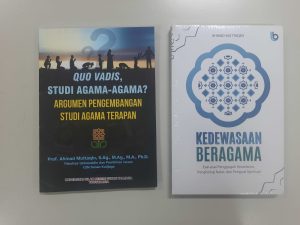
Saya masuk ruang disambut oleh penerima tamu dan daftar hadir. Alhamdulillah ada nama dan atas nama apa saya perlu hadir. Saya menghadiri atas nama Asosiasi Studi Agama Indonesia, yang biasa dipanggil ASAI. Daftar hadir sudah selesai saya tanda tangani. Lalu among tamu memberikan souvenir, salah satunya buku karya Prof. Ahmad Muttaqin, S.Ag., M.Ag., M.A., Ph.D. yang akan dikukuhkan hari ini. Ketika saya hadir, tidak semua kursi penuh. Saya masih dengan leluasa bisa memilih tempat duduk.

Tidak lama kemudian, acara pun dimulai. Seperti biasa, ada pembukaan, menyanyikan lagu kebangsaan dan hymne UIN Sunan Kalijaga Yogyakarta. Ketua senat menyapa para hadirin yang hadir. Di antaranya kolega Ketua ASAI dari jajaran pimpinan Muhammadiyah, Prof. Dr. Haedar Nasir, M.Si dan Prof. Dr. Muchlas, M.T., Rektor UAD Bersama dengan Wakil Rektor dan BPH UAD Yogyakarta. Tentunya dihadiri oleh keluarga besar UIN Sunan Kalijaga Yogyakarta dan Keluarga besar dari Profesor yang juga menjabat sebagai Wakil Direktur PPs UIN Sunan Kalijaga Yogyakarta.

“Jika kuliah di jurusan Perbandingan Agama atau Prodi Studi Agama-Agama, setelah lulus akan menjadi apa, kerja di mana?”, pertanyaan para siswa SLTA ketika sosialisasi prodi dilakukan ke sekolah dan madrasah inilah yang mengantarkan Ahmad Muttaqin pada capaian guru besarnya. “Kajian epistemologi, ontologis dan aksiologis untuk menghasilkan alumni menjadi manusia yang memiliki keimanan dan ilmuan yang kokoh perlu terus dilakukan karena PA/SAA tidak untuk mencetak tukang”, tegas beliau. Tidak berhenti sampai di sini, jawaban ini dipertanyakan lagi dalam riset-riset yang beliau lakukan.

Continue reading “Studi Agama Terapan: Cara Beragama yang Menggembirakan” →

Pseudoscience and Pseudoreligion in the Midst of an Epidemic

Ahmad Muttaqin


Humans are remarkably fragile. The arrogance shown in managing and exploiting nature is being challenged

Various methods, ranging from scientific approaches to spiritual practices, are being employed to combat the new Coronavirus. The healthcare sector is at the forefront, providing assistance and treatment to patients while working tirelessly to develop a vaccine for prevention. Meanwhile, the economic and social sectors are striving to mitigate the pandemic's impact, which has severely affected the industrial sector, trade in goods and services, and social life. At the same time, religious organizations are also offering spiritual support through prayer and comforting rituals.

Many people are questioning whether the new Coronavirus, known as SARS-CoV-2, which causes Covid-19 (Coronavirus Disease 2019), is a result of a natural process or human engineering. Proponents of conspiracy theories often argue that this virus was deliberately created in a laboratory for various interests, such as serving as a biological weapon or benefiting the vaccine and pharmaceutical industries. This article will not explore the pros and cons regarding the virus's origin. Instead, it will examine the level of "scientific reasoning and religious reasoning" reflected in the various responses from different parties in addressing the Covid-19 pandemic.

Amid the uncertainty surrounding the origin of the virus and the lack of a vaccine and cure for Covid-19, it is ideal to address this pandemic using a combination of scientific methods and religious beliefs. Science and technology serve to prevent, treat, and manage the physical impacts of Covid-19, while religion provides spiritual support, helping individuals remain steadfast and resilient in their faith.

Continue reading “Pseudoscience & Pseudoreligion di Tengah Wabah” →

Changes in the Religious Landscape Post Covid-19: The Role of Religious Studies

Ahmad Muttaqin

As we observe the various responses of religious communities to the pandemic, it leads us to consider the changes that may take place in the landscape of religious life after the pandemic. How can we bridge the gap between religious reasoning and scientific reasoning in society, enabling religious individuals to effectively deal with epidemics and other natural events? So that religion is always shalihun fi kulli makan wa zaman (In accordance with space and time). How can the Religious Studies address these questions?

___________________________

The April 2020 edition of Middle East Forbes published Khuloud Al Omian Article titled "Are we witnessing the awakening of a New World Order” The article listed 10 issues predicting changes in the new world order, including a shift in the global power axis, automation of production infrastructure, decline in the travel business sector, changes in education systems and patterns, social life, health, and the environment. Interestingly, none of the 10 points made by Al Omian examined the possibility of change in the field of religion and spirituality

Biju Dominic  dalam “Will Covid-19 weaken the base of organized religions?” menyatakan bahwa bencana dan musibah dapat mempengaruhi perubahan perilaku keberagamaan masyarakat baik secara positif maupun negative. Sebagai contoh, runtuhnya gedung WTC di New York mendorong masyarakat Amerika semakin “religious”. Hal ini berdasar trend meningkatnya warga yang memandang penting agama dalam kehidupan sehari-hari mereka sejak peristiwa 9/11 tersebut. Menurut data Gallup Research, sejak tahun 1960 masyarakat Amerika Serikat yang mengganggap agama itu penting dalam kehidupannya tidak lebih dari 40%. Namun, angka itu melonjak menjadi 70% sejak peristiwa 9/11. Sebaliknya, wabah penyakit pes abad 14 yang melanda Eropa menjadi penyebab makin redupnya peran hirarki gereja di Eropa. Awalnya, para pimpinan gereja waktu itu menyebut bahwa wabah penyakit itu bentuk hukuman Tuhan untuk para pendosa. Karena itu agar terhindar dari wabah tersebut, harus bertaubat dan banyak berdoa. Namun seiring wabah yg tidak kunjung berhenti, kepercayaan pada otoritas dan hirarki gereja makin pudar hingga kemudian di abad 15 memunculkan berbagai gerakan reformasi gereja.

Berangkat dari pengalaman sejarah sebagaimana dipaparkan Biju di atas, kira-kira seperti apa wajah agama dan potret keberagamaan pasca Covid-19?

Continue reading “Perubahan Lanskap Keberagamaan Pasca Covid-19: Apa yang Dapat Studi Agama-Agama Lakukan?” →

Religious Moderation and the Foundations of National Identity

The Master of Religion and Philosophy Study Program, along with the Master of Religious Studies and the Master of Quranic Science and Tafsir at the Faculty of Ushuluddin and Islamic Thought, UIN Sunan Kalijaga Yogyakarta, organized a Learning Socialization event for new students of the 2019/2020 academic year. This event took place on Thursday, March 5, 2020, in the Smart Room of the Faculty of Ushuluddin and Islamic Thought and was attended by 73 new students enrolled in the Master of Religions Program. During the event, Ahmad Muttaqin M.Ag., M.A., PhD, the Head of the Master of Religions Study Program, delivered a presentation on Religious Moderation and the Pillars of Nationality.

Ahmad Muttaqin M.Ag.,M.A, Ph.D
Ahmad Muttaqin, M.Ag., M.A., Ph.D., is providing material on socialization in learning.

Ahmad Muttaqin emphasized that a moderate attitude must begin with oneself and one's mindset. Instilling moderation from an early age involves suppressing and eliminating hatred and hostility among people. Promoting harmony among religious communities is essential for advancing Indonesia as a multi-ethnic, multicultural, and multi-religious nation, making it a more harmonious society.

"If you continue to see people of different religions as enemies or as reasons not to greet them, then you are not ready to be a moderate person. A moderate person recognizes differences as an opportunity to work together or even to enrich one another," he said.

Continue reading “Moderasi Beragama dan Pilar Kebangsaan” →