Kuliah Dekolonisasi dalam Studi Agama-Agama Bersama Prof. Abdulkader Tayob

Pascasarjana UIN Sunan Kalijaga Yogyakarta pada 26 April 2024 pukul 08.30-11.00 WIB berkolaborasi dengan Asosiasi Studi Agama Indonesia (ASAI) dan Prodi Studi Agama-Agama Fakultas Ushuluddin dan Pemikiran Islam menyelenggarakan kuliah umum tentang Decolonizing The Study of Religions. Kuliah yang dilaksanakan secara hybrid ini dihadiri oleh kurang lebih 75 orang peserta offline di aula pascasarjana dan lebih dari 50 orang peserta online melalui channel youtube dan ruang zoom. Kuliah ini menghadirkan Prof. Abdulkader Tayob dari University of Cape Town, Afrika Selatan.

Abdulkader Tayob yang biasa dipanggil Prof. AK adalah pemilik NRF Chair in Islam, African Publics and Religious Values, Religion Education. Ada banyak karya yang telah diterbitkan beberapa di antaranya tentang Religion as Discourse dan Decolonizing the Study of Religions. Beberapa karya itu dapat diakses melalui website https://humanities.uct.ac.za/department-study-religions/contacts/abdulkader-tayob.

Prof. AK memulai kuliah dengan satu pertanyaan, yaitu “Apakah dekolonisasi itu mungkin?” Pertanyaan tersebut diturunkan menjadi pertanyaan yang lain, “Dapatkah kita benar-benar pergi melampaui saat ini? Sementara dalam penjelasannya, ada post-colonial sebagai dampak dari agama “modern” saat ini. Ada agama dan sejarah yang membentuknya di global south selain sejarah agama yang dikonstruksi oleh global north. Agama bukan hanya sebagai sesuatu untuk dipatuhi dan dijalankan, tapi agama berperan untuk bertahan hidup dan perlawanan di Afrika. Diskursivitas dekolonisasi di global south yang menjadi catatan bahwa agama dikonstruksi. Tak lupa ada etika yang dapat dilibatkan dalam religious discourse. Sehingga ketika berbicara tentang agama di ruang publik bukan hanya agama sebagai identitas, tetapi juga agama sebagai etika. Selain pertanyaan-pertanyaan tersebut, Prof. AK juga menyebutkan beberapa rujukan tokoh dalam studi Dekolonisasi, antara lain: Grosfuguel, Nelson Maldonaldo-Torres, An Yountae. Bagaimana selengkapnya? dokumentasi acara ini dapat ditonton di channel Pascasarjana UIN Sunan Kalijaga https://www.youtube.com/watch?v=AKAXoZukU0Q ini.

Salah satu alasan kenapa kuliah ini diselenggarakan adalah “kajian dan riset dekolonisasi tidak banyak dilakukan oleh ilmuwan, terutama ilmuwan muslim di Asia”, sebagaimana diungkapkan oleh Prof. Nur Ichwan, moderator, ketika mengawali kuliah ini. Prof. Nur Ichwan juga menegaskan bahwa dekolonisasi bukan topik marginal di komunitas sosial Indonesia. Jadi, ketertarikan studi dekolonisasi di Indonesia masih terbatas. Apakah Anda akan mengkajinya dalam studi dan riset selanjutnya? [MT]
Reading the Metamorphosis of Comparative Religion

Oleh :

Muryana, S.Th.I., M.Hum.
(Asosiasi Studi Agama Indonesia)

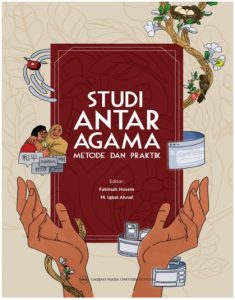
In mid-December 2023, I was asked to respond to the book "Interreligious Studies: Methods and Practices," written by Zainal Abidin Bagir and others. The book features 11 chapters authored by 10 men and 1 woman. My understanding of the book highlights two key points. First, it emphasizes the differences in methodology among Comparative Religion, Religious Studies, and Interreligious Studies. Second, it addresses how programs in Comparative Religion, Religious Studies, and Interreligious Studies are managed at universities.

I gathered insights from three important writings. The first is by Zainal A. Bagir, who emphasizes that Interreligious Studies should be viewed as a branch of religious studies. The second writing, by Nur Ichwan, discusses the approach of Religious Studies at IAIN/UIN Sunan Kalijaga Yogyakarta, which leans towards Methodological Agnosticism. The third piece, authored by Robert Setio, explores the concept of Contextual Theology in Interreligious Studies. These three articles prompted me to ask some critical questions: "What is the difference between religious studies at UIN and UGM?" and "What should Comparative Religion, Religious Studies, and Interreligious Studies focus on next?" I found some answers in an additional eight articles.

The eight writings include Robert Setio's analysis of the practical benefits of these studies for graduates' careers. Bernard Adeney-Risakotta's work discusses interreligious studies with a focus on respecting the diversity of religion and theology. Frans Wijsen explores the five shifts in religious studies within a discourse framework. Daniel K. Listijabudi offers insights into hermeneutics as applied to interreligious studies. Ricardo Vargas Posada maps dissertations produced by students in the Interfaith Studies program. Mohammad Iqbal Ahnaf emphasizes the importance of religious literacy for a better understanding of religion. Izak Y.M. Lattu and Faitmah Husein examine the role of dialogue in fostering social cohesion. Lastly, Leonard C. Epafras questions the concept of religious authority and explores how divine power has shifted in the context of "Religion for Adsense" in the digital age. Through these writings, I've discovered that the management of Comparative Religion, Religious Studies, and Interreligious Studies significantly influences the success of interreligious cooperation. A key determinant is the institution under which these studies are organized, whether it is a religious or non-religious institution. This factor affects whether students from diverse religious backgrounds feel comfortable and can thrive in their studies. Consequently, experiences related to comparative religion, religious studies, and interfaith studies are systematically imparted to students, potentially enriching their perspectives. In this context, I observe the success of the Indonesian Consortium for Religious Studies (ICRS), UGM in promoting itself as a reputable doctoral program for those interested in studying interfaith issues. However, I do believe it is problematic to directly compare the learning experiences of undergraduate students at UIN with those of doctoral students at UGM.

Continue reading “Membaca Metamorfosa Perbandingan Agama” →

Making Comparative Religion a Perspective

Writen by: Muryana, S.Th.I, M.Hum

I would like to share my experiences as a resource person during the Redesign Curriculum Workshop on the Religious Studies, which I attended some time ago. My first question is: what prompted the redesign of the curriculum? Secondly, what type of graduates does the Religious Studies program aim to produce?

I began by recalling the courses I took while studying Comparative Religion. Next, I reviewed the current curriculum. Although the courses offered are largely similar, there are some new additions. Based on this comparison, an important skill for alumni of Comparative Religion, I identified a structure that I could follow. First, I study my own religion. Second, I explore other people's religions. Third, I learn various approaches and tools to analyze both my religion and others. Finally, I am encouraged to determine which religion I wish to pursue further.

I learned about my own religion through various courses, previously referred to as institutional courses, as well as courses specifically focused on Islam and those that provide a foundation for understanding it. The subjects I studied include the Qur'an, Hadith and their sciences, Arabic, Fiqh, Sufism, the History of Islamic Civilization, and Tafsir. I recall Dr. Moh Damami Zein explaining in class that studying at State Institute for Islamic Studies (IAIN) serves as a bridge between Islamic boarding schools and higher education. This implies that one of the prerequisites for attending IAIN is ideally having a foundational understanding of Islamic studies from the previous school level. Consequently, education at IAIN is not designed for beginners in religion; rather, the Islamic courses offered are intended for further analysis and advanced study. Will this shake our faith as Muslims? There are many concepts and tools that need to be learned in order to conduct careful and in-depth analysis. Personally, I find myself increasingly eager to deepen my understanding of Islam at this stage in my studies.

Continue reading “Menjadikan Perbandingan Agama sebagai Cara Pandang” →

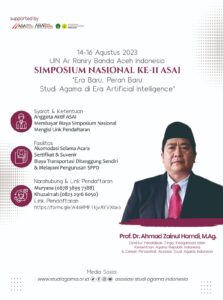
SIMPOSIUM ASAI KE 11 ; Era Baru, Peran Baru Studi Agama di Era Artificial Intelligence

Assalamu’alaikum wr.wb.,
Mengharap kehadiran Ibu/Bapak Anggota ASAI dalam agenda Simposium Nasional #11 ASAI pada tanggal 14-16 Agustus 2023 di UIN Ar Raniry Banda Aceh Indonesia dengan mengusung tema “Era Baru, Peran Baru Studi Agama di Era Artificial Intelligence” yang akan dihadiri oleh Direktur Pendidikan Tinggi Keagamaan Islam Kementerian Agama Republik Indonesia sekaligus Dewan Penasehat Asosisasi Studi Agama Indonesia Prof. Dr. Ahmad Zainul Hamdi, M.Ag.

simposium asai 11

Untuk link pendaftaran klik https://forms.gle/A46RMFTkjvAYVXax5

info lebih lanjut bisa menghubungi

Muryana (087838997388)

Khuzaimah (082329166050)

Reminder Diskusi Rabu Malam ASAI; Satu Jam Bersama Profesor

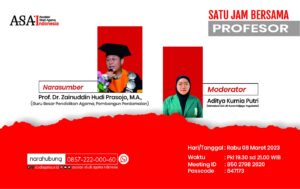
Mengharap kehadiran Ibu/Bapak/Ibu/Sdr/i dalam Seri Sejam Bersama Professor: Prof. Dr. Zaenuddin Hudi Prasojo, M.A.
Pada: Hari/tanggal: Rabu, 8 Maret 2023
Pukul: 19:30-21:00 WIB
Meeting ID: 850 2798 2620
Passcode: 847173
Join Zoom Meeting
https://us02web.zoom.us/j/85027982620?pwd=TlQwc1lod1EyRGsrZzJCbklnWkNRdz09

Find your local number: https://us02web.zoom.us/u/kdCxLxlyjD
Kegiatan ini diselenggarakan oleh Asosiasi Studi Agama Indonesia (ASAI).
.
Follow akun media sosial kami untuk update informasi & kegiatan lainnya.
Info lebih lanjut hubungi CP: 0857 222 000 60
Silahkan kunjungi medsos kami:
IG: @asosiasistudiagamaindonesia
Youtube: Asosiasi Studi Agama Indonesia
FB: Asosiasi Studi Agama Indonesia
Website: www.studiagama.or.id
#studiagamaagamaindonesia
#perbandinganagama
#fakultasushuluddin
#uinsunankalijagayogyakarta
#uinsunanampelsurabaya
#uinalauddinmakassar
#uinantasaribanjarmasin
#uinsumedan
#uinradenintanlampung #uinimambonjolpadang
#uinarraniry

Call For Book Chapter on 10th ASAI

Call For Book Chapter on 10th ASAI
📖📒📔📓📚
ASAI (Asosiasi Studi Agama Indonesia) mengudang Ibu/Bapak/Sdr/i pegiat Studi Agama-Agama di Indonesia untuk menulis dengan tema naskah sebagai berikut:
1. Dinamika Agama Lokal di Indonesia
2. Penelitian Keagamaan: Pendekatan, Teori dan Metode
3. Arah Baru Studi Agama di Indonesia
📄Tulisan maksimal 3500-5000 kata, Times New Roman 12
📝 Naskah kami terima sejak tanggal 10 Juni-10 Juli 2022
📧 Silahkan dikirim ke alamat email: asosiasistudiagamaindonesia@gmail.com
.
.
.
Follow akun media sosial kami untuk update informasi & kegiatan lainnya.
Info lebih lanjut hubungi CP: 085722200060
Silahkan kunjungi medsos kami:
IG: @asaionline
Youtube: Asosiasi Studi Agama Indonesia
FB: Asosiasi Studi Agama Indonesia
Website: www.studiagama.or.id

REFORMULATING THE CHALLENGES OF RELIGIOUS STUDIES IN INDONESIA #2

Muryana, S.Th.I., M. Hum

MBKM Based on Alumni Data or Religious Studies Enthusiast Data?

What context exists beyond practice? For me, MBKM is not solely about practicing, especially concerning its administration. Rather, MBKM raises the question, "Where do you want to take Religious Studies?"

When I entered Religious Studies, I always remembered and echoed the idea that Comparative Religion/Religious Studies does not produce craftsmen. So, what does this mean? This sentiment is essential as it guides our understanding of graduate competency. During a recent Religious Studies alumni meeting at UIN Sunan Kalijaga Yogyakarta, it was emphasized that "the appropriate formulation of graduate competency will address job opportunities for Religious Studies alumni." This conclusion suggests that Religious Studies must respond to labor market needs, thereby recognizing that its alumni are indeed craftsmen. Similarly, I believe that the MBKM initiative is designed to align with market demands. Students are given the opportunity to study for three semesters to gain the necessary skills and prepare for employment after graduation. Therefore, education in this context is directly linked to workforce readiness. It is not surprising that the Islamic Education study program is more popular than Comparative Religion/Religious Studies, as the job market for Islamic Education graduates is clearer. Given this perspective, the implementation of MBKM should be based on the provisions that Religious Studies prepares for its alumni. What specific provisions and skills do these alumni acquire from their studies in Religious Studies? Continue reading “MERUMUSKAN KEMBALI TANTANGAN STUDI AGAMA-AGAMA DI INDONESIA #2” →

Reformulating the Challenges of Religious Studies in Indonesia #1

Muryana, S.Th.I., M. Hum

Honestly, when I was asked to share about "Proposed Ideas for Implementing MBKM in Religious Studies," I felt confused. What should I share?

The Practice of MBKM at Sekolah Riset Satukata

Allright, I will begin with the following image: Continue reading “MERUMUSKAN KEMBALI TANTANGAN STUDI AGAMA-AGAMA DI INDONESIA #1” →

Merumuskan Kembali Tantangan Studi Agama‐Agama di Indonesia

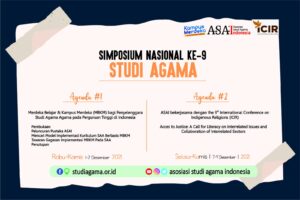
ASAI gelar simposium nasional ke-9 dengan tema “Merdeka Belajar& Kampus Merdeka (MBKM) Bagi Penyelenggaraan Studi Agama Agama Pada Perguruan Tinggi Di Indonesia”. Agenda ini dilaksanakan pada tanggal 1-2 desember melalui platform zoom online.

Agenda ini bekerja sama dengan Rumah Bersama Insectoral Collaboration On Indigenous Religions (ICIR). Menghadirkan Keynote Speech Prof. Dr. Sekar Ayu Aryani, M.A, Tim Perumusan Kurikulum MBKM serta Pengurus dan Panitia ASAI.

Simposium ke-9 ASAI dilaksanakan dalam rangka membahas dua agenda. Pertama, membongkar ulang gagasan studi agama agama pada dunia kerja. Hal ini merupakan jawaban dari keresahan para sarjanawan atas implentasi kurikulum studi agama agama yang selama ini di nilai belum dapat menarik minat para pencari kerja.

Tantangan ini berangkat dari Permendikbud Nomor 3 Tahun 2020 pasal 18 tentang Standar Nasional Pendidikan Tinggi yang mengamanatkan 1) memperoleh capaian pembelajaran (learning outcomes), mahasiswa sepenuhnya mengambil mata kuliah pada prodinya. 2) memperoleh capaian pembelajaran, sebagian mata kuliah dapat mengambil dari luar prodinya, baik di lingkungan perguruan tingginya sendiri maupun di perguruan tinggi lain termasuk kegiatan magang di lapangan.

Kegiatan ini akan diwujudkan sebagai pertukaran pelajar dengan bobot substansi 50 % Ilmu Ke-Islaman,  20 %  Sains, 20%  Life Skill, dan 10 % TIK, dengan begitu diharap dapat menciptakan kultur belajar yang inovatif, tidak mengekang, dan sesuai dengan kebutuhan mahasiswa. Pertukaran pelajar ini juga diharapkan dapat menjadi pioneer untuk keilmuwan yang saling terintegrasi-interkoneksi.

Agenda kedua yaitu memperkenalkan perpustakan online yang dapat di akses melalui Web ASAI. Hal ini untuk mempermudah para pustakawan dalam mengakses buku-buku studi agama dan menjawab perkembangan zaman dengan teknologi yang semakin militan.

Simposium ke-9 Studi Agama

Assalamu’alaikum wr.wb.,
Mengharap kehadiran Ibu/Bapak Anggota ASAI dalam agenda Simposium Nasional #9 ASAI pada hari Rabu-Kamis, 1-2 Desember 2021 dan Selas-Kamis 7-9 Desember 2021 via zoom meeting.
Ibu/Bapak yang bersedia hadir, silahkan mengisi link berikut:
https://forms.gle/kCgkRjpSf9HThnWU6

Info lebih lanjut hubungi CP: 082329166050
salam sehat dan bahagia.
Tim ASAI
Wassalamu’alaikum wr.wb.