
 As science and technology rapidly advance, we face numerous humanitarian challenges that require a collective response. One significant challenge is the diminishing awareness of care, love, empathy, and social intimacy. This issue is closely linked to the swift progress of information technology, which often fosters private spaces and undermines warm interpersonal relationships. The resulting social implications include the strengthening of transactional relationships between individuals and groups. In such conditions, qualities like closeness, love, and empathy become scarce, leading to relationships that are reduced to mere subject-object interactions. This situation poses a risk to humanity, as people begin to view others merely as accessories to their own comfort, neglecting the importance of caring for those around them.
This challenge pertains to the religious studies, focusing on how values contribute to building positive relationships. The decline of love and social intimacy in human interactions is a crucial aspect of contemporary religious studies, emphasizing the importance of social context (milieu) at the levels of ontology, epistemology, and axiology. This study area can be further developed within the department of Religious Studies at Indonesian universities. The field of Religious Studies engages deeply with the various changes occurring in society. Consequently, a solid academic foundation is essential, acknowledging that societal changes are closely linked to religious issues. In more specific terms, religion is examined from a diverse range of perspectives. The findings from religious studies provide valuable insights into societal transformations.
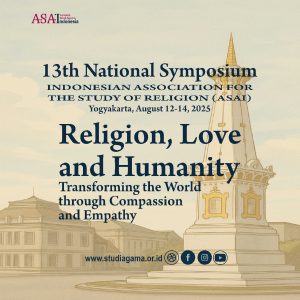
The 13th ASAI National Symposium on Religious Studies in 2025 will address the theme "Religion, Love, and Humanity: Transforming the World through Compassion and Empathy." This follows the previous year's theme, "The New Era: The New Role of Religious Studies in the Era of Artificial Intelligence," held in Aceh, and the 12th National Symposium's focus on "Religion and Climate Change: Exploring Responses" in Banjarmasin. The goal of this year's symposium is to feature speakers from the International Association for the History of Religions (IAHR), the Indonesian Ministry of Religious Affairs, and the Presidential Communications Office, all aimed at highlighting the significance of Religious Studies, previously known as Comparative Religion.
The symposium will include several sub-themes for discussion as part of the International Conference, including:
1. Religion and Love in Religious Texts
2. Literature and Artworks about Religion and Love
3. Information Technology and Global Humanitarian Challenges
4. Public Policy in Maintaining Diversity
5. Religious Studies and Philanthropic Movements
6. Religion and the Environment for Humanity
7. Study of Figures Concerned with the Issues of Religion and Love
8. Conflict Resolution Based on Religion and Love
9. Deep Learning, Deeper Religiosity
10. Spatial Awareness in Religion
11. Religious Healing and Psychotherapy
This event aims to foster meaningful dialogue and insights into the impactful intersection of religion, love, and humanity.
We invite lecturers and students majoring in religious studies from across Indonesia, as well as other academic enthusiasts interested in contemporary studies, and communities of religious scholars, to participate. This includes members of ASAI and its affiliated institutions. You can register through the following link: https://bit.ly/PendSimpoNas13ASAI If you have any questions, please contact us via WhatsApp at 0878 3899 7388 or 087 222 000.
We look forward to welcoming you to Jogja, the city of Indonesian students!
2025 National Symposium on Religious Studies Explores the Theme of Love

 English (UK)
  Bahasa Indonesia
Enjoy the simposium ASAI
Senang membaca web ini berselancar penuh harapan